
Fieldwork: Researching bastakor creativity in Uzbekistan, Sept-Dec 2025
Eugene Leung travelled to Uzbekistan between September and December to conduct fieldwork for his PhD dissertation, on creativity in Uzbek classical music. Based in Tashkent, he was attached to the Yunus Rajabiy Institute of National Musical Arts (UzMMSI), immersing in its musical life, whilst also travelling to cities such as Bukhara, Samarqand and Andijan to engage with musicians and musical institutions in these cities.
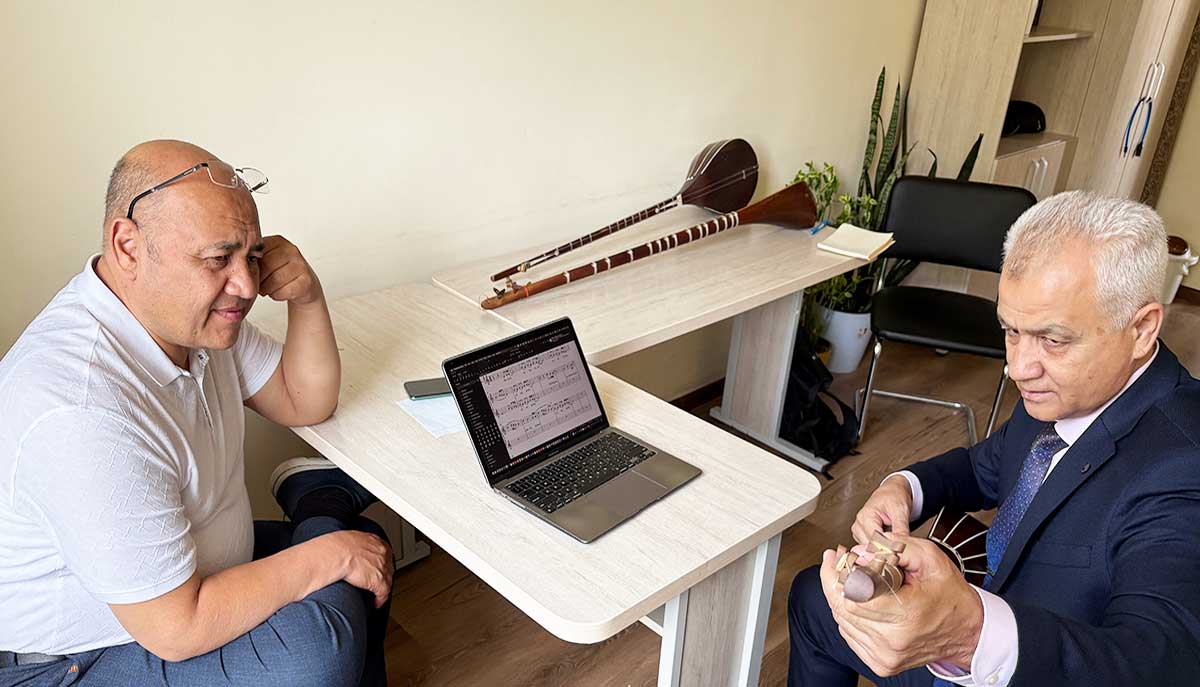
Abror Zufarov and Salohiddin Azizboyev, teachers at the UzMMSI, discussing Eugene’s compositional attempts. September 2025
Eugene’s research interests lies in questions surrounding the creation of new, autonomous pieces – asar – in the Uzbek classical music tradition: how did the idea of creating new pieces by individual, named composers (bastakor) emerge in this tradition? How are the pieces’ individuality defined? How are such creativities underpinned by the music theories of the various maqom traditions, other classical genres, as well as changing contexts of performance and audience preferences? How are such knowledge transmitted in the present day? In this first phase of his PhD fieldwork, Eugene has observed musical transmission at the UzMMSI, as well as travelled to other cities to understand their musical transmission and compositional traditions. In each city he has engaged with contemporary musicians active in rethinking music theory as well as in composing within the tradition.
Members of the Bukhara Maqom Ensemble rehearsing Mo’g’ulchai Fig’on, a composition by its member, Ustoz Eshpolat Ortiqov. October 2025
Samarqandi bastakor and singer Farhod Qori Halimov analysing the intervallic structure of Ey Sarvi Ravon, a classical song (ashula) by the bastakor Saidjon Kalonov. November 2025
Tags: Bastakor, Bukhara, Central Asia, Creativity, Fieldwork, Maqām Beyond Nation, Maqom, Samarqand, Tashkent, Uzbek, Uzbek National Institute of Musical Arts Named After Yunus Rajabiy