
Recent Posts
- Uzbek Maqom Workshop at SOAS with Ilyos Arabov
- Concert at SOAS by the Ilyos Arabov Ensemble
- Music and Dance of Bukhara: Spiritual Heartland of Central Asia
- Bastakor creativity in Uzbekistan
- Saeid Kordmafi Delivers Lecture at the Research Institute of Cultural Studies and Intangible Cultural Heritage, Uzbekistan
- Professor Owen Wright Receives the 2025 British Academy Derek Allen Prize
- “Capturing Practice” by Mukaddas Mijit and Rachel Harris
- Symposium in Baku April 2026
- “Chegra Bilmas Maqom”A collaboration on Central Asian Maqām across Borders
- Visit to the Yunus Rajabi Institute
- Visit to the Farg’ona Maqom School and the Marg’ilan Maqom Theatre
Masterclass with Ilyos Arabov
Concert at SOAS: Music and Dance of Tajikistan
The Team
- Rachel Harris
- Giovanni De Zorzi
- Polina Dessiatnitchenko
- Saeid Kordmafi
- Mukaddas Mijit
- Aziz Isa Elkun
- Rosa Vercoe
- Eugene Leung
- Will Sumits
Categories
Archives
Featured Category
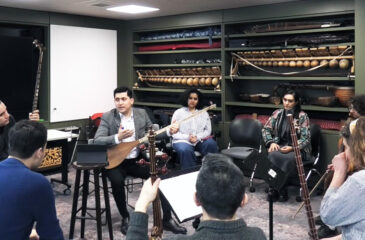
Uzbek Maqom Workshop at SOAS with Ilyos Arabov
By Eugene Leung Ilyos Arabov, Honoured Artist of Uzbekistan, Professor and Head of the Instrumental Performance Department at the Yunus Rajabiy Institute for National Musical Arts, gave a workshop at SOAS on 26 February 2026. The aim of the workshop was to allow musicians with proficient with other maqām traditions to have a first experience in performing maqom-based Uzbek music, with an emphasis on its intricate ornamentations, also known as nola (“sighing”) in Uzbek. […]
-

Music and Dance of Bukhara: Spiritual Heartland of Central Asia
-

Bastakor creativity in Uzbekistan
-

Saeid Kordmafi Delivers Lecture at the Research Institute of Cultural Studies and Intangible Cultural Heritage, Uzbekistan
-

Professor Owen Wright Receives the 2025 British Academy Derek Allen Prize
-

“Chegra Bilmas Maqom”A collaboration on Central Asian Maqām across Borders
-

Strand 7: Bastakor and maqām-based creativity in Uzbekistan
-

Strand 1: Maqām across the Soviet-Chinese divide
-

Strand 2: Migrant memories, migrant creativities
Maqām Beyond Nation
Maqām Beyond Nation explores a field of music-making that stretches from North Africa to Central Asia; a set of historically fluid and inter-connected creative practices which were transformed under 20th century nationalisms into fixed repertoires. The project seeks to understand the major changes which are now weakening these nationalist models. We attend to the musical materials and their potential for new creativity, and to the social: how a focus on expressive culture can further our understanding of the aesthetics of religious revival and cultural responses to the experience of forced migration. Our case studies are fault lines across the maqām world – among them the former Soviet-Chinese border, and the border between Iran and Azerbaijan – key spaces where shared traditions of music-making were split apart by the formation of new nation states. To understand these spaces, we draw on archival, analytical and ethnographic research, as well as practice- based creative collaboration. Our findings will be shared through an exciting programme of workshops and conferences, publications and films, collaborative performances and compositions. Read more >>