
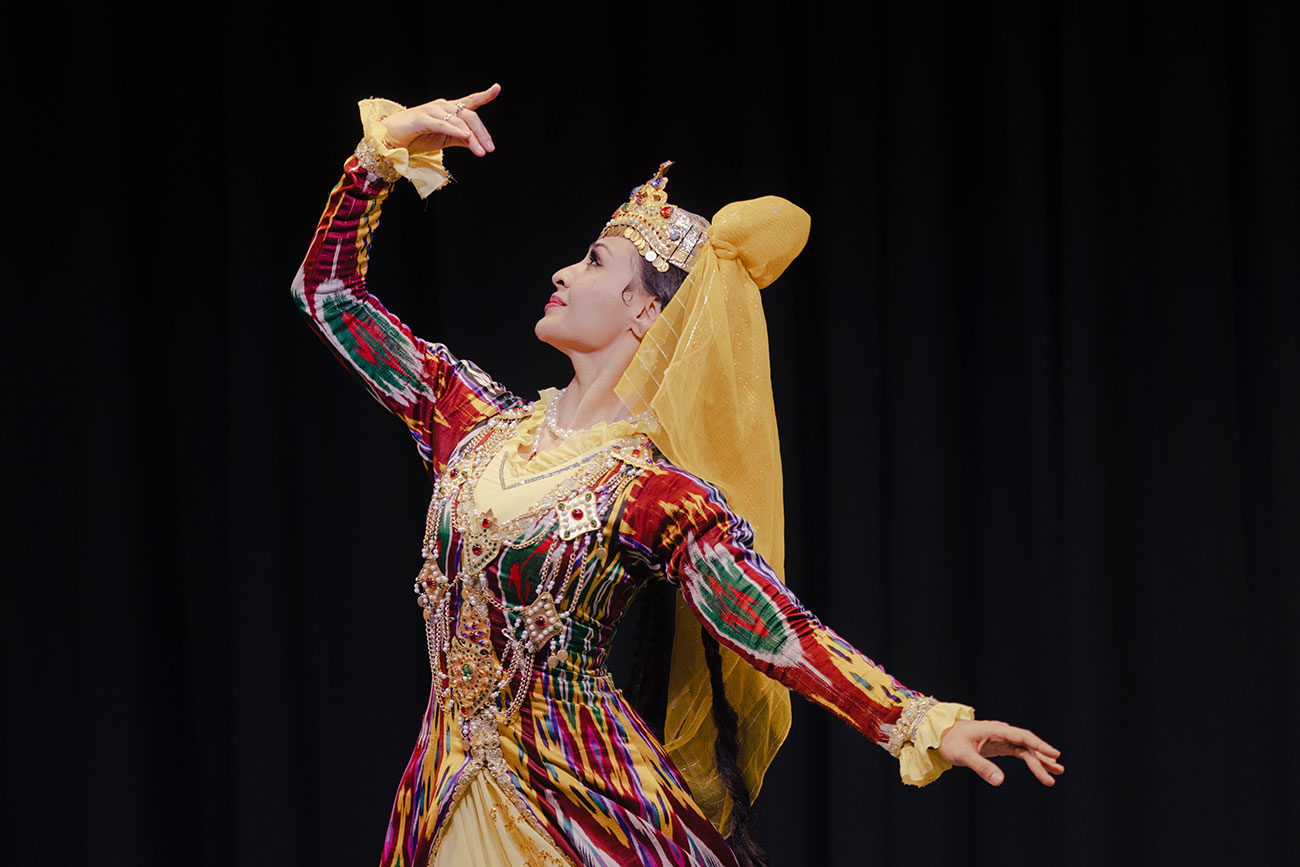
Photo credits to © Mike Skelton
On 27 February 2026, the Ilyos Arabov Ensemble performed at the Brunei Gallery Lecture Theatre, SOAS University of London, presenting the rich musical and dance traditions of Bukhara.
Ilyos Arabov: Vocals, Tanbur (long-necked plucked lute), Sato (long-necked bowed lute), Dutor (long-necked plucked lute), Doira (frame drum)
Farangiz Makhmudova: Dutor
Nasimkhon Muzaffarov: Doira
Vosidjon Makhmudov: Ghijjak (short-necked bowed lute)
Dilorom Madrakhimova: Dance
Where Boundaries Dissolve
Bukhara and its musics testify to the cultural diversity of Central Asia. The city embodies multiple forms of border-crossing. In Bukhara the principal languages of classical poetry (Tajik Persian and Uzbek Turkic) find space to coexist; classical, folk, and devotional musical genres intermingle; and Sufi aesthetics and Jewish musical artistry developed together within a shared urban tradition. Notwithstanding the political transformations of the twentieth century, Bukhara remains a site where the boundaries melt away.
The city’s long history as a centre of Islamic scholarship, and especially Sufism, made it a major pilgrimage destination, celebrated as “Bukhārā-yi Sharīf” (Noble Bukhara). This religious prominence has its musical counterpart in the Bukharan Shashmaqām, the pre-eminent repertoire of Central Asian art music, of which early versions in the nineteenth century were composed based on Persian poetry. The Shashmaqām is the product of complex cultural dynamics, above all the patronage from the court of the Bukharan Emir. It is the primary source for the modern national musical canons of both Tajikistan and Uzbekistan.
Video: 1 Ilyos Arabov sings Saraxbori Navo, Uzbek ghazal by Sakkoki
Shashmaqām, as its name indicates, consists of six grand suites, each named after their core melodic mode. Each suite comprises an instrumental section (Mushkalāt) and a vocal part containing two sub-suites: Nasr and Sawt. Following a predetermined energy map, these sub-suites begin with compositionally sophisticated pieces and conclude with lighter ones.
Drawn from folk music, the tarāna interludes in the first vocal branch function as breaks between the weightier pieces. Various versions of Shashmaqām realise this grand structure in different ways, and there is historical evidence of the coexistence of Tajik and Uzbek languages in versions of Shashmaqām at least from the late nineteenth century.
Video 2: Ilyos Arabov sings Chapandozi Navo, Tajik ghazal by Nozim
The Music and the Musicians
One of Uzbekistan’s leading vocalists, and a multi-instrumentalist, Ilyos Arabov exemplifies Bukhara’s linguistic and musical heritage. Born and raised in Bukhara, he speaks Tajik Persian as well as the Uzbek national language. Arabov studied the dutār with masters of the city, but despite his talent for maqam singing, his mentors discouraged him from beginning serious vocal training too early, in order to protect his voice. It was only later in the Tashkent conservatoire that he learned the vocal art of Shashmaqām, mainly through the Uzbek canonical version. Even so, his familiarity with the Persian language has enabled him to maintain a connection with both classical and folk repertoires of his hometown. Arabov is joined by his regular ensemble of top musicians from Uzbekistan’s Yunus Rajabiy Institute, and leading practitioner of traditional dance, Dilorom Madrakhimova.
The programme, specially curated by Saeid Kordmafi and Ilyos Arabov for the tour, is unique in various ways. The performance of a cohesive Shashmaqām suite, as presented here, is rare in Central Asia today. Arabov’s arrangement of Maqām Navā illustrates how maqam performance can be fluid, flexible, and responsive to different contexts, revealing the creative potential of the Shashmaqām repertoire beyond the rigid canonical structures.
This suite creatively traverses the boundaries between the canonical branches of Maqām Navā. The vocal section begins with Nasir, but halfway through—from Chapandāz-i Navā—it switches to the Sawt branch. The instrumental piece Mukhammas Husaynī gives the vocalist a brief rest while showcasing the dutār, and the final energetic Ūfar welcomes the dancer.
The pieces come mainly from the Uzbek Shashmaqām yet the performance also includes three Persian-language pieces. The first Tarāna is based on Tajik lyrics, and Chapandāz-i Navā is adopted from a Tajik rendition by the celebrated Jewish singer, Barno Ishakova. The concluding piece, Ūfar-i Navā, moves beyond a simple linguistic switch. Arabov takes the lyrics of Ūfar from the Tajik Shashmaqām and its melody from the Uzbek version. As the melodies differ slightly between the two repertoires, fitting the text of one onto the melody of the other requires creative adaptation.
The second part of the programme, also bilingual, is devoted to works by twentieth-century Uzbek composers (bastikār) and folk repertoires of the Tajiks and Uzbeks (khalqī). It culminates in the Mavrigī, a Bukharan dance suite. Together with the women’s repertoire of Bukhārcha, Mavrigī constitutes the celebratory music of the city, where the subtleties of Bukharan dance take centre stage. With modal flavours from Iranian music, Mavrigī is an entirely Persian-language repertoire existing in the heart of Uzbekistan; yet another indication of Bukhara’s unique intercultural position, and the linguistic and musical versatility of its musicians.
Saeid Kordmafi, February 2026
Video 3: Ilyos Arabov sings a suite of pieces in contrasting meters from the second shobe of Navo: Mughulchai Navo. Dance by Dilorom Madrakhimova.
Full Programme
Part 1: Maqom Navo
Introduction, improvisation on the Sato
Tasnif and Gardun-i Navo (Instrumental)
Sarakhbori Navo, Uzbek ghazal by Sakkoki
First and second Taronas, Uzbek folk lyrics
Chapandozi Navo, Tajik ghazal by Nozim
Mukhammasi Husayni (instrumental), solo Dutor
Mughulchai Navo, Uzbek ghazal by Munis
Talqinchai Mughulchai Navo, Uzbek ghazal by Atoyi
Qashqarchai Mughulchai Navo, Uzbek ghazal by Nodira
Soqinomai Mughulchai Navo, Uzbek ghazal by Avaz
Ufari Mughulchai Navo, Tajik ghazal by Sahbo
Part 2: Bastakor and Khalqi
Bozurgoni, composed by Haji Abdulaziz Abdurasulov, Uzbek ghazal by Vola and Uzbek mukhammas by Fazli
Qomati, composed by Sharif Akramov, Uzbek ghazal by Navoyi
Chorzarb (folk), Uzbek ghazal by Amiri
Na bolghay va Aylab keling, composed by Mukhammadjon Mirzaev, Uzbek ghazals by Hamid Olimjon and Zavqi
Mavrigi (folk), Tajik folk lyrics
The names of composers, poets, pieces and instruments in the programme list are transliterated according to contemporary orthographic conventions.
Tags: Bukhara, Ilyos Arabov Ensemble, Maqām Beyond Nation, Maqom, SOAS, Uzbekistan