
29-30 April 2026, Azerbaijan National Conservatory, Baku
As part of the “Mugham Beyond Borders” symposium at the Azerbaijan National Conservatory in April 2026, we invited Sashar Zarif to share his research and to present a curated excerpt from “Dancing Mugham,” the path-breaking collaboration between two great artists born on different sides of the Azerbaijan-Iran border.
Alim Qasimov was born 1957 in a small Soviet commune north of Baku. He was selected to study in the state music school in Baku and went on to become one of the foremost mugham singers in Azerbaijan, renowned for his fluid and expressive vocal improvisation, and his creative and innovative approach, which is inspired in part by Iranian classical music and South Asian performance style.
Qasimov has also enjoyed a distinguished international career. Since the 1980s he has toured widely, with concerts in Iran, Brazil, the United States and throughout Europe. He has released a series of albums including The Art of Mugham(1997) and Spiritual Music of Azerbaijan (2007). His innovative performance style and openness to new projects have won him a host of awards and accolades.
Zarif’s family history carries migration across generations, from Central Asia into Iran before his birth, and then his own move from Iran through Turkey to Canada as a teenager. These layered ruptures remain a quiet undercurrent in his work. They are often directly symbolized by his grandmother’s frame drum.
He discovered Alim Qasimov’s voice through one of his early albums, and describes the experience as one of “listening to a running river… I surrendered my body, mind, and emotions, and I just whirled.” Zarif went on to create a series of dance projects based on Qasimov’s music and inspired by the spiritual poetry of Qasimov’s mugham repertoire. In 2004, the two artists began to work together, and over the years they have produced a series of collaborative projects centred on mugham, Sufi-inflected poetry, and the whirling sama dance.
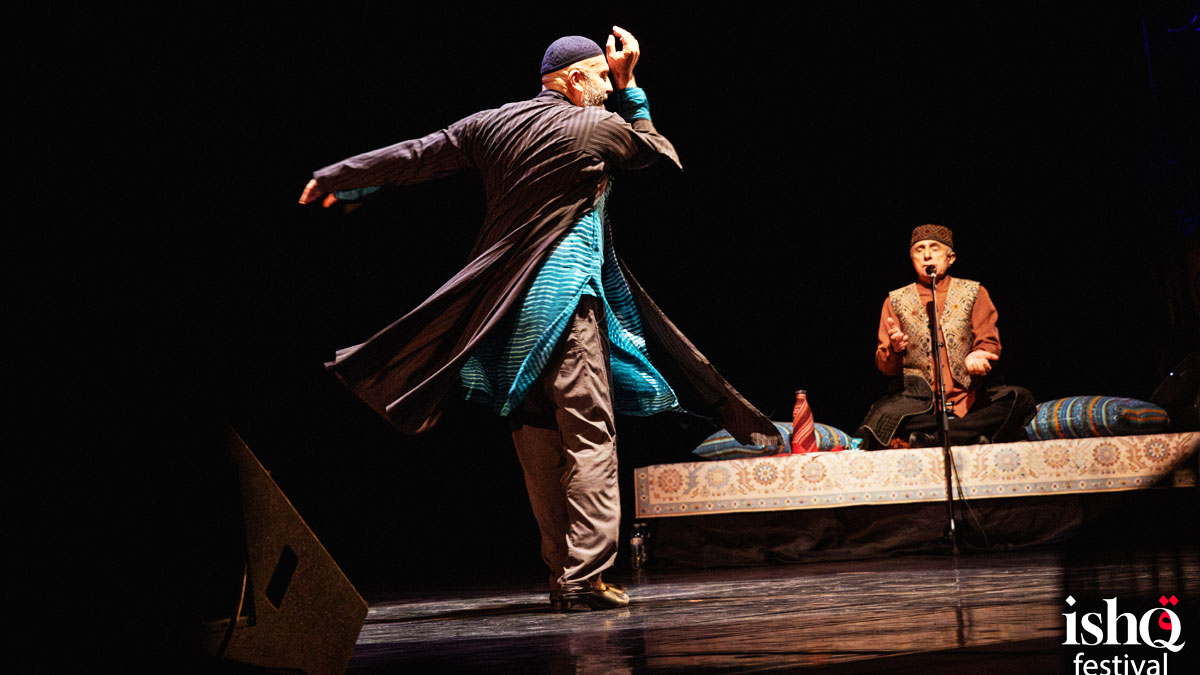
Qasimov and Zarif in performance at the Ishq Festival, October 2025
Zarif’s collaboration with Qasimov represents one strand within a broader international practice. Since 1993, his practice has taken him across some forty countries through performances, workshops, and residencies. His research and deeper collaborative work are rooted in cultures connected to Sufi and shamanic traditions, spanning from Central Asia to North Africa, building an integrated methodology called Living Stories that treats movement, sound, and memory as a single embodied process. Within that framework, Dancing Mugham and the ongoing work with Qasimov represent a sustained inquiry into mugham as spiritual and structural knowledge, rooted in embodied ethnographic research where creation and investigation work together.
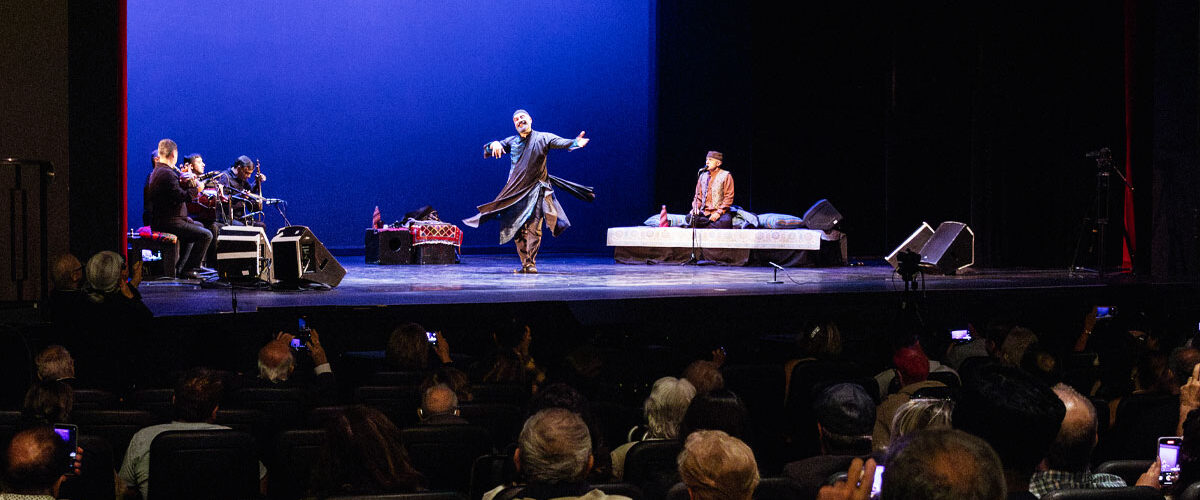
Performance at the Azerbaijan Conservatory, April 2026
Zarif says:
“My practice spans from 1993 onward — over thirty years, across some forty countries, through performances, workshops, and residencies. Dancing Mugham started specifically with Alim in 2004, and we’re now twenty-two years into that collaboration. But it sits within a much broader ecosystem of work with other master musicians in maqam and Sufi traditions across multiple continents.”
“I also want people to understand how the work actually functions. The creative process draws on rehearsal conversations, artist notes, media, audience reflections, and collaborative exchanges. The approach involves deep listening. Movement often emerged not from preset choreography but from listening. The musicians and dancer functioned as integrated voices, responding to the body as much as the body responded to sound. They began to perceive the body not as dancing to music, but as the very instrument through which music breathes.
“The dance operates within a structured vocabulary rooted in mugham principles. This vocabulary has developed through intimate study of mugham music and the poetry it carries, with direct awareness and connection to their form and content — the vocabulary and sections are clearly structured, but the execution remains improvisational rather than fixed step-by-step choreography.
“The composition itself is co-developed — the music and the choreography shape each other, rather than one simply serving the other. The physical, embodied experience of the dance has itself shaped the musical structure, producing zikr-inflected passages built in dialogue with the rhythmic patterns of the aruz poetic meter, where the embodied rhythm develops to the point that the dancing body sometimes leads, or departs from, the music rather than following it.”
“Sema” demonstrates the richness of a collaboration nurtured over a period of two decades. The close interaction between vocalist, musicians, and dancer lends a fluidity to the work, aided by the unique staging which places Qasimov to the right, facing his musicians on the left of the stage, ensuring that the dancer is placed at the centre of the creative feedback loop.
Watching Sema is a most joyful experience, an intimate, embodied excursion into the Sufi notion of spiritual love (ishq). It highlights Qasimov’s openness to new ideas and his willingness to cross boundaries in his musical practice. Zarif’s contemporary performance evokes the figure of the merry dervish. His movement communicates pure delight in Qasimov’s improvised music and poetry, demanding that the audience experience with him its insistent call that physically pulls both performer and audience into the dance.
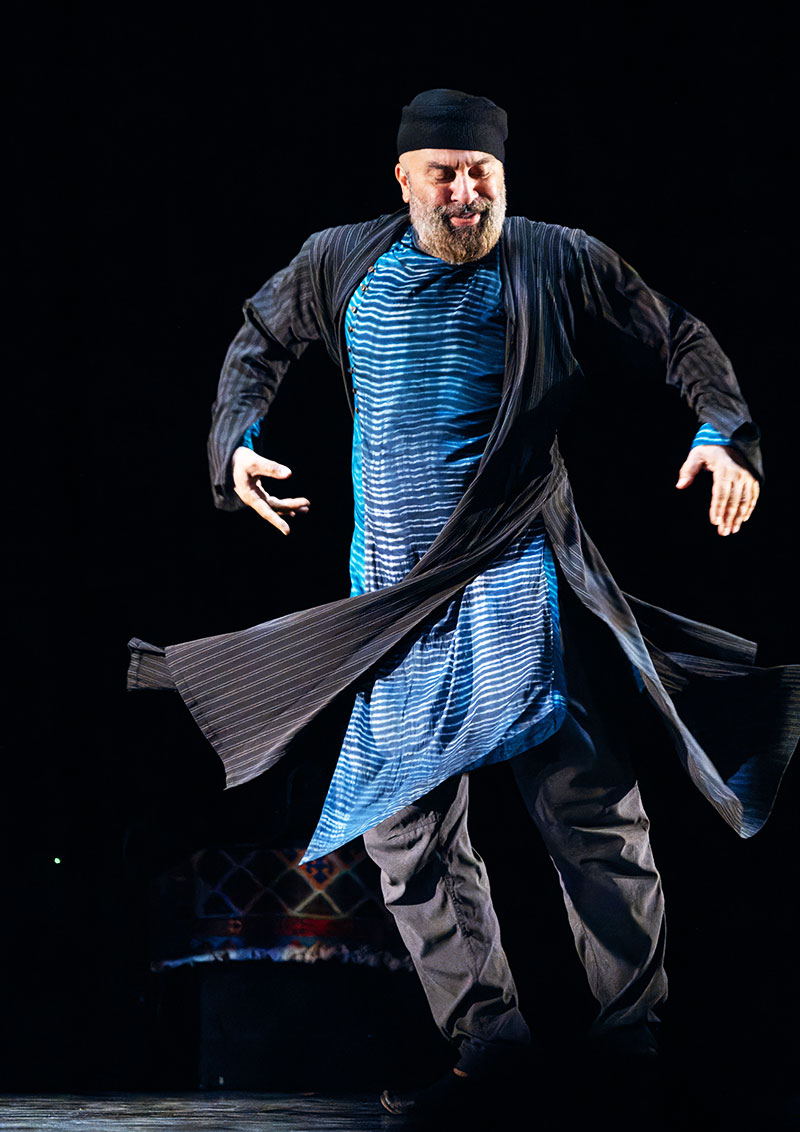
Zarif in performance at the Ishq Festival, October 2025
Tags: AlimQasimov, Azerbaijan, Mugham, SasharZarif, Sema