
By Eugene Leung
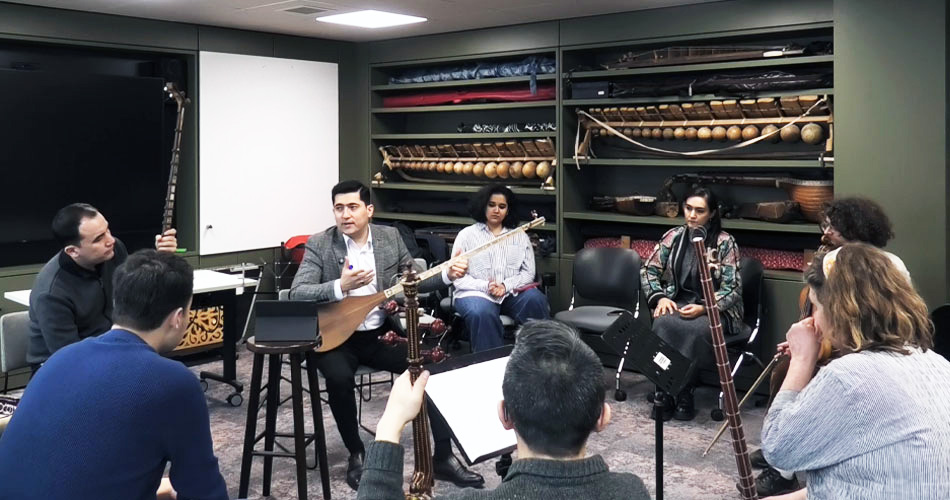
Ilyos Arabov, Honoured Artist of Uzbekistan, Professor and Head of the Instrumental Performance Department at the Yunus Rajabiy Institute for National Musical Arts, gave a workshop at SOAS on 26 February 2026. The aim of the workshop was to allow musicians with proficient with other maqām traditions to have a first experience in performing maqom-based Uzbek music, with an emphasis on its intricate ornamentations, also known as nola (“sighing”) in Uzbek. For this workshop, Ilyos chose a short suite from the Ferghana-Tashkent maqom tradition, “Sharob I-II”, for which he provided a reference recording as well as his own score. The SOAS Middle Eastern Ensemble was joined by members of the Miras Silk Road Ensemble in this workshop in learning this suite over a few weeks in January and February before the workshop, focusing on learning its core melody.
At the workshop, Ilyos, together with member of his ensemble, guided the participating musicians through the pieces, first by explaining how the frame drum rhythmic cycle (usul) comes from the folk genre yalla, whose dance-like character should underpin performances. Ilyos then worked on the pieces with the musicians phrase by phrase, demonstrating how they ought to be realised on each instrument, ornamenting according to the characteristics of each instrument but within the idiom of Uzbek classical music. Ilyos’ hands-on demonstration on a variety of instruments, such as the plucked lute tanbur, the strummed lute dutar, the fiddle ghijak, and the zither qanun, allowed participating musicians to observe in detail the mechanics of ornamentation, where a single note on the transcription may need to be realised by a complex combination of gestures.
Ilyos Arabov SOAS Workshop 20260226 -video 1
Ilyos explained that, each of these ornaments are so specific to each instrument that it is not feasible to notate them in the score. He explained after the workshop, however, that for him, the score is still useful in fixing the melodic outline for ensemble performance. This sets him apart from the purely aural learning method that is still quite prevalent in Uzbekistan. The two-hour workshop concluded with a wide-ranging discussion about the Sufi connotations of the piece – Sharob’s literal meaning, “wine”, as a metaphor for divine love that fills the cup that is the human heart – as well as on differences among regional styles.
Participating musicians appreciated the opportunity to work directly with these master musicians. Dilzat Turdi from the Miras Silk Road ensemble particularly appreciated “how they broke down to the smallest details such as ornamentation and emotional interpretation. Hearing the subtle details in melodic development was special to me.” Jack Szczuka from the SOAS Middle Eastern ensemble said he was “surprised by the qanun style [that Ilyos demonstrated], but as soon as I started doing it, it felt natural for the type of music we are playing.”
Ilyos Arabov SOAS Workshop 20260226 – video 2
Tags: Ferghana-Tashkent Maqom, Ilyos Arabov Ensemble, Maqām Beyond Nation, Maqom, SOAS, Uzbekistan, Workshop