
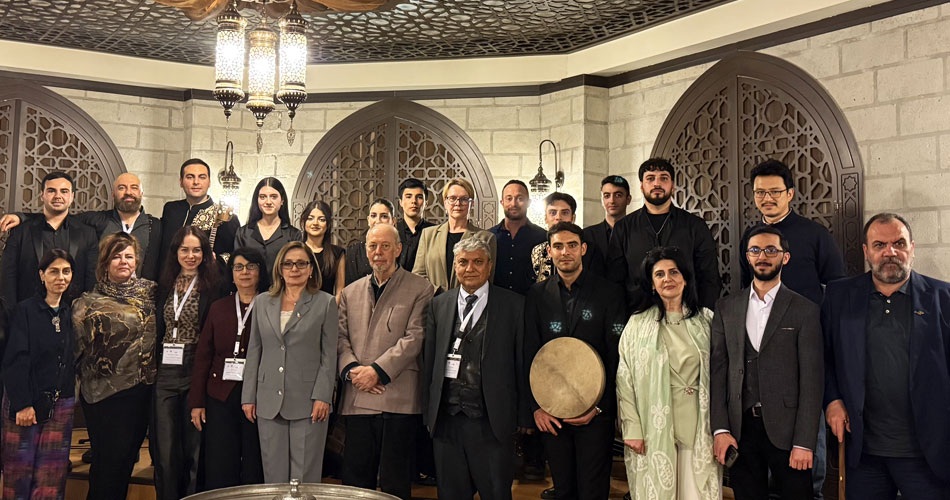
On April 29-30, 2026, “MAQAM” members Polina Dessiatnitchenko and Rachel Harris, in collaboration with the Azerbaijan National Conservatory (hereafter ANC) and the ICTMD “Maqam” group, organized an international symposium “Azerbaijani Mugham Across Borders.” The two-day event featured a keynote speech by Jean During, individual papers, heated debates, and wonderful music performed by students from the ANC.
The opening ceremony commenced with a speech by the Rector of ANC, Kamila Dadashzade who warmly welcomed all the participants. She underlined the importance of the symposium’s main topic about how maqam repertoires are connected to each other in terms of history, musical structure, poetry, aesthetics and spirituality. The Miraz Ancient Folk Instruments Ensemble, comprised of conservatory’s students, then performed old regional pieces, based on ethnomusicological work being done at the ANC. Indeed, the creativity of young musicians from the conservatory was truly inspiring. As part of the final concert, the “Ün” (Voice) ensemble played their own newly composed chahargah tasnif to the poetry of Shah Ismail Khatai. We also enjoyed a performance by acclaimed multi-disciplinary artist and researcher Sashar Zarif, whose profound concept of “mugham dance” was vividly demonstrated at his concert with Alim Gasimov.
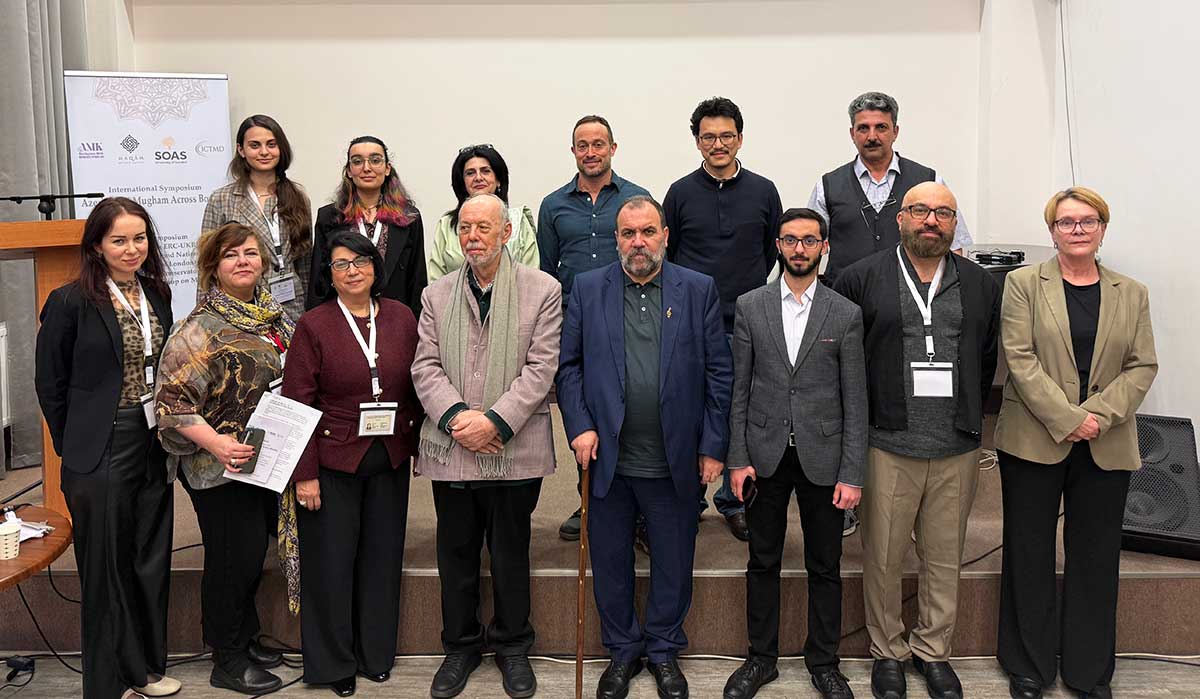
One of the main aims of the symposium was to provide a space for rigorous discussions about how maqam repertoires are linked, and moreover, expose critical issues and persistent biases in approaching Azerbaijani music as canonized, frozen repertoire. The event proceeded in two languages—English and Azerbaijani—and presenters made sure to deliver their ideas in both languages in order to facilitate understanding and discussion. As such, the exchange of views on crucial topics, such as Soviet reforms, restoration of mugham, limits of creativity, and the position of dance in musical traditions in Azerbaijan, was both very interesting and impactful.
Jean During gave a fascinating keynote talk comparing forms, techniques, and styles of improvisation in different maqam branches. Rachel Harris spoke about her own cross-border project between Uzbek and Uyghur maqom/muqam traditions, and co-authored presentation by Polina Dessiatnitchenko and Saeid Kordmafi analyzed the creativity of Azerbaijani musicians influenced by classical music from Iran. Many scholars also highlighted the centrality of religious and spiritual themes that underline connections between maqam branches, like the falak theme discussed by Lala Huseynova, philosophy of Fuzuli explained by Alexander Djumayev, or Sufi ideas detailed by Fakhraddin Salim Bakhshaliyev. There were also wonderful presentations by practitioners, such as the singer and poet Aghakarim Nafiz whose works maintain links to much broader Eastern literary traditions. Turan Ibrahimov talked about Aghakarim’s legacy, while the singer himself performed live to demonstrate these ideas. Mehman Mikayilov discussed his immense projects to restore mugham, and he played excerpts of shur mugham on the tar. In addition, there was an interesting panel about instrument circulation, including Will Sumits talking about how musicians modified and adopted instruments across borders at the turn of the 20th century, and Aysu Sadigova showing how Turkish qanun playing influenced the Azerbaijani qanun school.
Other presentations included: Giultekin Shamili delineating maqam modal system in Jewish melodies and religious rituals, Alexandra Balandina talking about makam discourses and practices in Greece, Beyimkhanim Valiyeva discussing the development of mugham singing by key performers, Alexandria Sultan Von Bruseldorff applying vocal science and pedagogy approaches to Azerbaijani mugham, Fardin Mahammadzade highlighting the prevalence of aruz meters in mugham, Zeynab Baghir focusing on the xoyrat genre in Iraqi Turkmen music and possible links to Azerbaijani music, Azer Chalabiyani detailing the music and aruz connection in the treatise Buhur Al-Alhan, and Kanan Sadigov providing an overview of performance techniques on the tar and similar traditions in the vicinity.
Highlights of the symposium
After the symposium ended, many conversations continued and possible new projects were being discussed. The themes of this symposium resonated deeply with new approaches to maqam as a transborder musical repertoire, beginning to be embraced at the ANC. As Lala Huseynova mentions, there are interesting musical processes that can be observed today because “Mugham performers, including both instrumentalists and singers, are freely borrowing musical elements from other maqam repertoires.” According to her, scholarship on this topic is crucial and the symposium was successful at highlighting relevant case studies from a cross-disciplinary perspective. Many graduate students at the ANC attended and participated at the symposium, noting how useful the new connections and ideas have been for developing their own academic work.
All the presentations will be published in English in the ANC’s journal Konservatoriya in the summer of 2026.
Tags: Azerbaijani Mugham, Baku, Maqam, Maqām Beyond Nation, Mugham